There was a time when magic happened on stage.
Then it moved closer—into the hands of close-up magicians, across restaurant tables, and into living rooms.
Now?
Magic happens on phone screens.
And strangely enough, that makes it feel even more impossible.
Modern audiences are surrounded by technology every day. They understand apps, touchscreens, editing, filters, and digital effects. That familiarity creates an unexpected challenge for magicians:
Traditional tricks can sometimes feel disconnected from modern life.
But when magic happens inside a spectator’s own device, the reaction changes completely.
Because now the impossible is happening in a place they trust.
Why “Digital Magic” Feels More Real
People expect magic props to be gimmicked.
They do NOT expect:
-
their own phone
-
their own tablet
-
their own screen
to become part of the illusion.
That’s what makes modern interactive effects so powerful.
The audience instinctively believes:
“If it happened on MY device… it must be impossible.”
And that psychological shift is huge.
The New Generation of Production Effects
Classic production magic has always relied on surprise.
A dove appears.
A cane materializes.
A bouquet emerges from empty hands.
But today’s audiences have seen visual effects everywhere:
-
movies
-
TikTok edits
-
CGI
-
AI videos
So modern production magic needs something more than appearance alone.
It needs interaction.
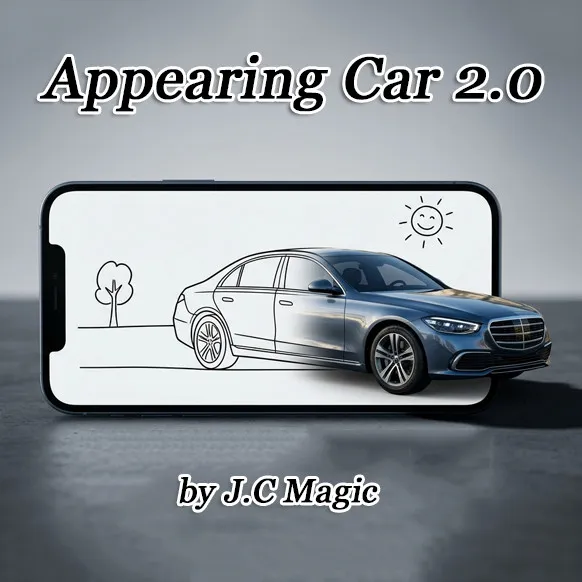
That’s exactly why effects like Appearing Car 2.0 by J.C Magic feel so modern.
A Drawing That Becomes Real
The premise is beautifully simple.
A spectator’s phone is borrowed.
A car is sketched on the screen using a drawing app.
Then—
The drawing comes alive.
A real model car emerges directly from the device.
Not from a box.
Not from a hidden compartment.
From the screen itself.
Why This Gets Such Strong Reactions
The effect works because it combines three layers of impossibility:
1. Familiar Technology
People understand phones.
Which means they instinctively know:
physical objects should NOT come out of them.
2. Personal Involvement
The magic happens on THEIR device.
That removes emotional distance from the effect.
They don’t feel like observers anymore.
They feel involved.
3. Visual Logic
A drawing becoming real is something the brain instantly understands.
No explanation is needed.
The effect is:
-
visual
-
immediate
-
emotionally satisfying
Social Media Changed Audience Psychology
This matters more than many magicians realize.
Modern audiences consume short-form visual content constantly.
That means:
-
attention spans are shorter
-
visual clarity matters more
-
effects must register instantly
An effect like Appearing Car 2.0 fits perfectly into this environment because:
-
the premise is immediate
-
the visual payoff is strong
-
the moment is camera-friendly
It feels designed for modern culture.
But Modern Magic Isn’t Only About Visuals
Here’s the interesting part:
Even in a world dominated by visual content, some of the strongest reactions still come from pure mentalism.
Not because it’s flashy.
Because it feels impossible in a deeper way.
Why Thought-Of Card Effects Never Die
A spectator merely THINKS of a card.
No force.
No touching.
No suspicious moves.
And somehow the magician knows it.
That plot has survived for decades because it attacks something fundamental:
private thought.

Dream Prediction – Simplicity Creates Power
Many mentalism effects become complicated.
Too many steps.
Too much procedure.
Dream Prediction strips everything away.
A single prediction remains visible from the beginning.
The spectator only thinks of a card.
And in the end?
The prediction matches perfectly.
Why Clean Structure Matters
The strongest mentalism effects are often the simplest.
Dream Prediction works because:
-
there is one prediction
-
it stays visible
-
there are no apparent moves
That creates a feeling of fairness.
And fairness is critical in mentalism.
The cleaner the structure appears, the stronger the impossibility becomes.
Visual Magic vs Mental Magic
Interestingly, these two effects represent opposite sides of modern magic.
|
Visual Production
|
Mentalism
|
|
Fast reactions
|
Slow tension
|
|
Immediate surprise
|
Psychological impact
|
|
Highly visual
|
Emotionally unsettling
|
|
Social-media friendly
|
Deeply memorable
|
And that’s why combining them is so effective.
A modern performer might:
-
open with a visual digital production
-
then transition into psychological impossibility
Hook first.
Then mystery.
What Modern Audiences Really Want
It’s not just “tricks.”
Audiences want moments that feel:
-
personal
-
impossible
-
emotionally real
Technology-based magic creates astonishment because it invades familiar spaces.
Mentalism creates astonishment because it invades private thoughts.
Both feel deeply modern.
Final Thought
Magic evolves with culture.
Years ago, producing a dove felt impossible.
Today, making an object emerge from a smartphone may feel even stranger.
And despite all our technology, one thing hasn’t changed:
People still desperately want to experience something they cannot explain.
That’s why modern interactive magic works.
Not because it fools the eyes.
Because it briefly breaks the audience’s understanding of reality.